

Skip to Scale Lens

A measure of energy

KARDASHEV

How far can a civilization reach?

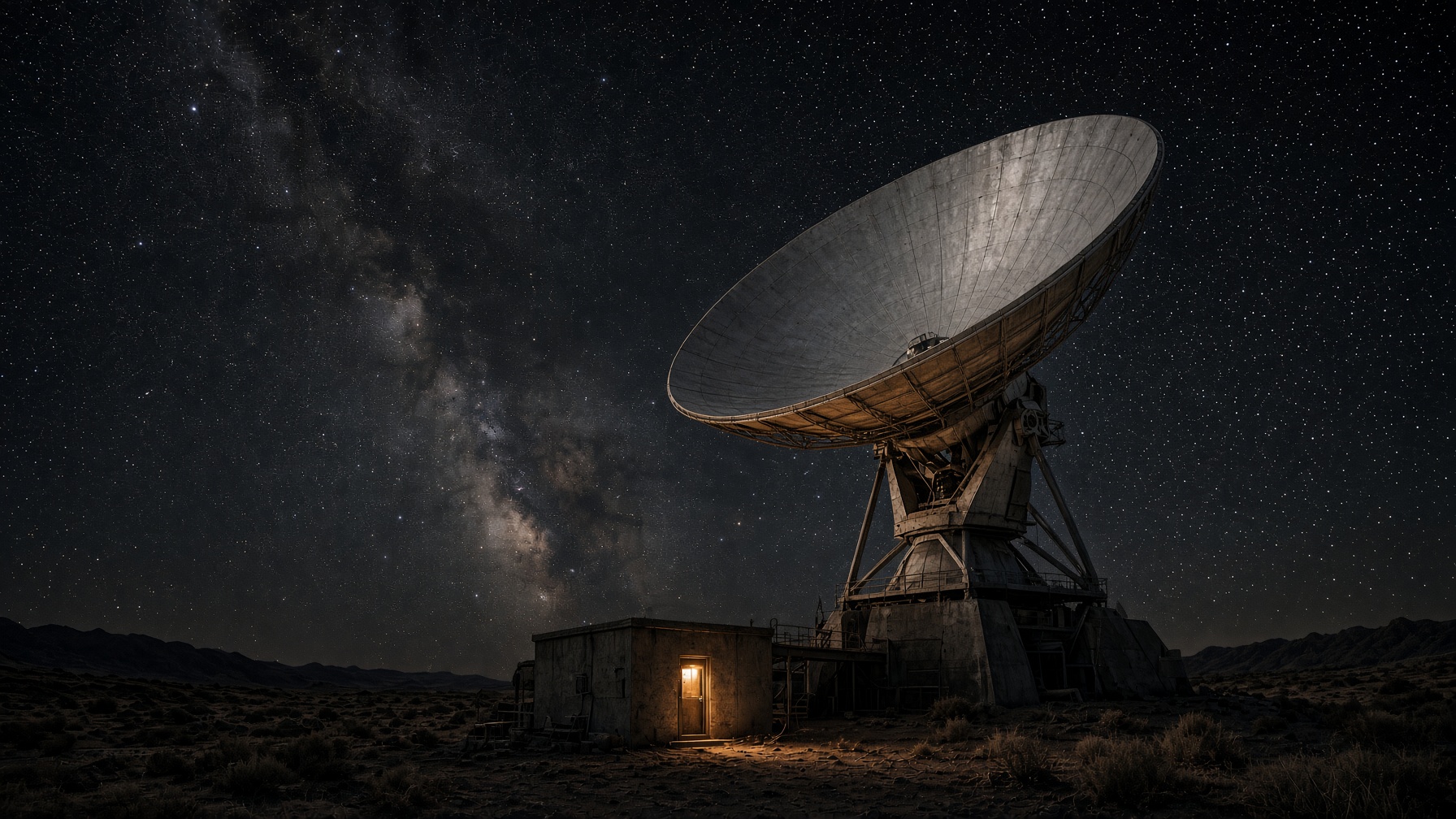
A radio dish turns under a night sky. In 1964 Nikolai Kardashev asked what power a distant civilization would need, to be heard.

A watt

One joule each second

Darkness, then a small light. A watt is a rate: one joule of energy every second. Everything else on this scale is a multiple of this.

SI. Power, not a pile of energy.

Night-side Earth, city lights as warm filaments.

Earth, 2025

The Earth of 2025

In 2025 Earth’s total energy supply is read as 600.3 exajoules. Spread through a Julian year that is 1.90 × 10¹³ W. Under Sagan’s 1973 interpolation, as printed in Carrigan 2009, K ≈ 0.728. The index is derived. It is not a rank.

Energy Institute Statistical Review 2026, TES 2025, via IEEJ.

A radio telescope dish under a night sky.

1964

The original question

Nikolai Kardashev was thinking about radio information from possible extraterrestrial civilizations. More power might change which signals could be sent, and what distant observers might detect. A thought experiment about energy and communication.

Kardashev 1964 original. Type I described the Earth of that paper.

The paper asked what power would be needed to be heard.

1964 original · log₁₀ watts

Three powers. One paper.

Linear paper cannot hold these three. The marks sit where the logarithms sit. Touch a type. The Scale Lens answers in that neighborhood.

  1. a galaxy

    11 orders of magnitude

  2. a star

    14 orders of magnitude

  3. the Earth of the paper

N. S. Kardashev, Transmission of Information by Extraterrestrial Civilizations”, Soviet Astronomy 8 (1964): 217–221. Type I described the Earth of the paper, not a finished planet.

The Scale Lens

Place

Place a point

Linear paper cannot hold a watt beside a star. Place a point, or weigh two. Watts are joules per second.

A radio dish under a night sky.

Scale Lens

A log spine of power. One touch. Watts are joules per second.

Touch the spine, or a named station.

1 W1964IIIIII

No point yet.

Night-side Earth from orbit.

Type I

Planetary magnitude

Later convention sets Type I near 1 × 10¹⁶ W. Kardashev’s 1964 Type I was 4.0 × 10¹² W, the Earth he could name. The scale names available power at planetary size. It does not finish a planet.

Modern planetary convention. 10¹⁶ W.

The star

A star’s whole light

The Sun’s nominal luminosity is 3.8 × 10²⁶ W. That number is an IAU 2015 convention, not the Sun’s changing real-time output. Earth’s intercepted sunlight is a tiny disk in this field. The star is the rest.

IAU 2015 Resolution B3. Nominal solar luminosity.

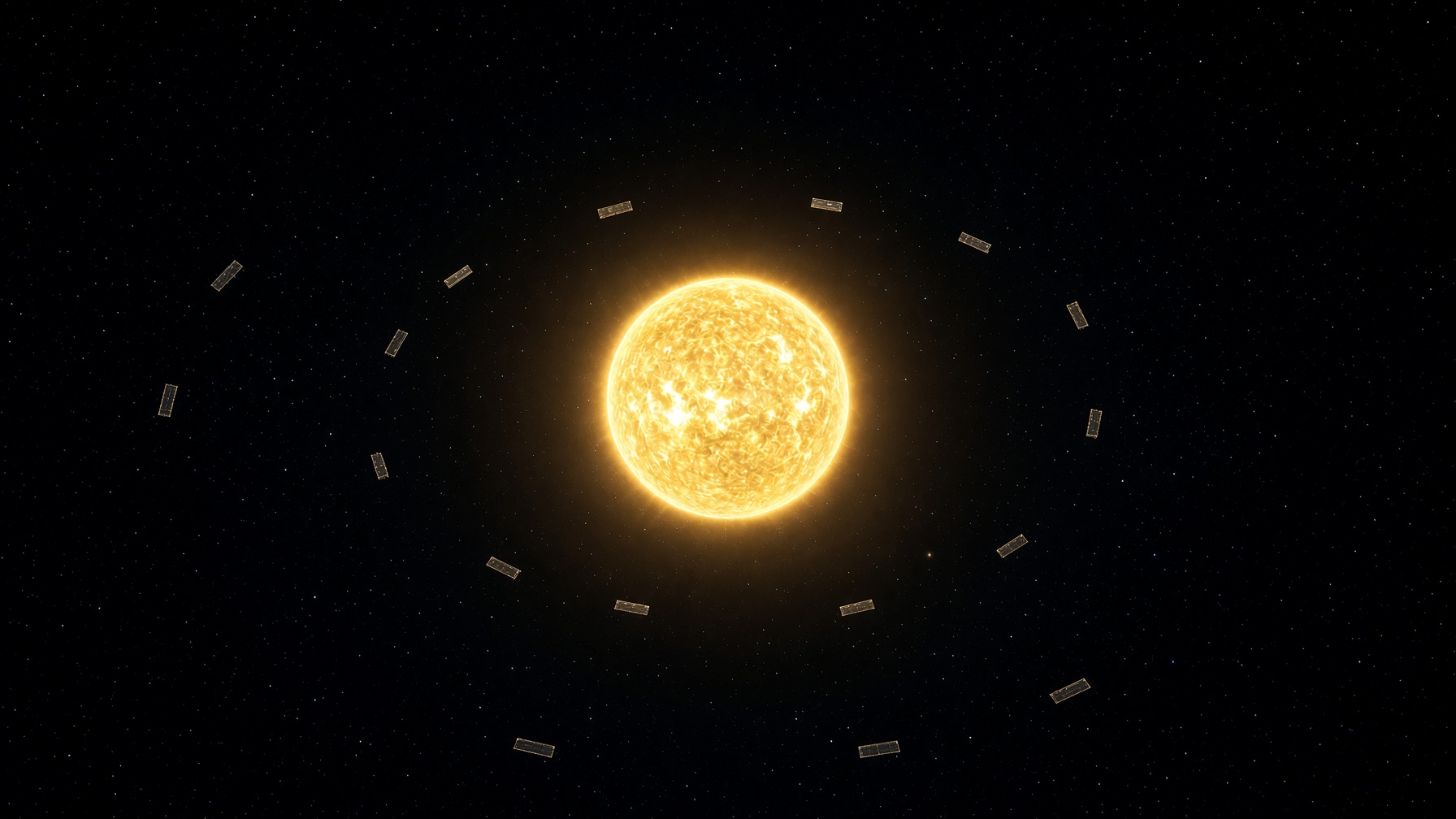
Concept art of a sparse Dyson swarm around a visible star.

Type II

A swarm, not a shell

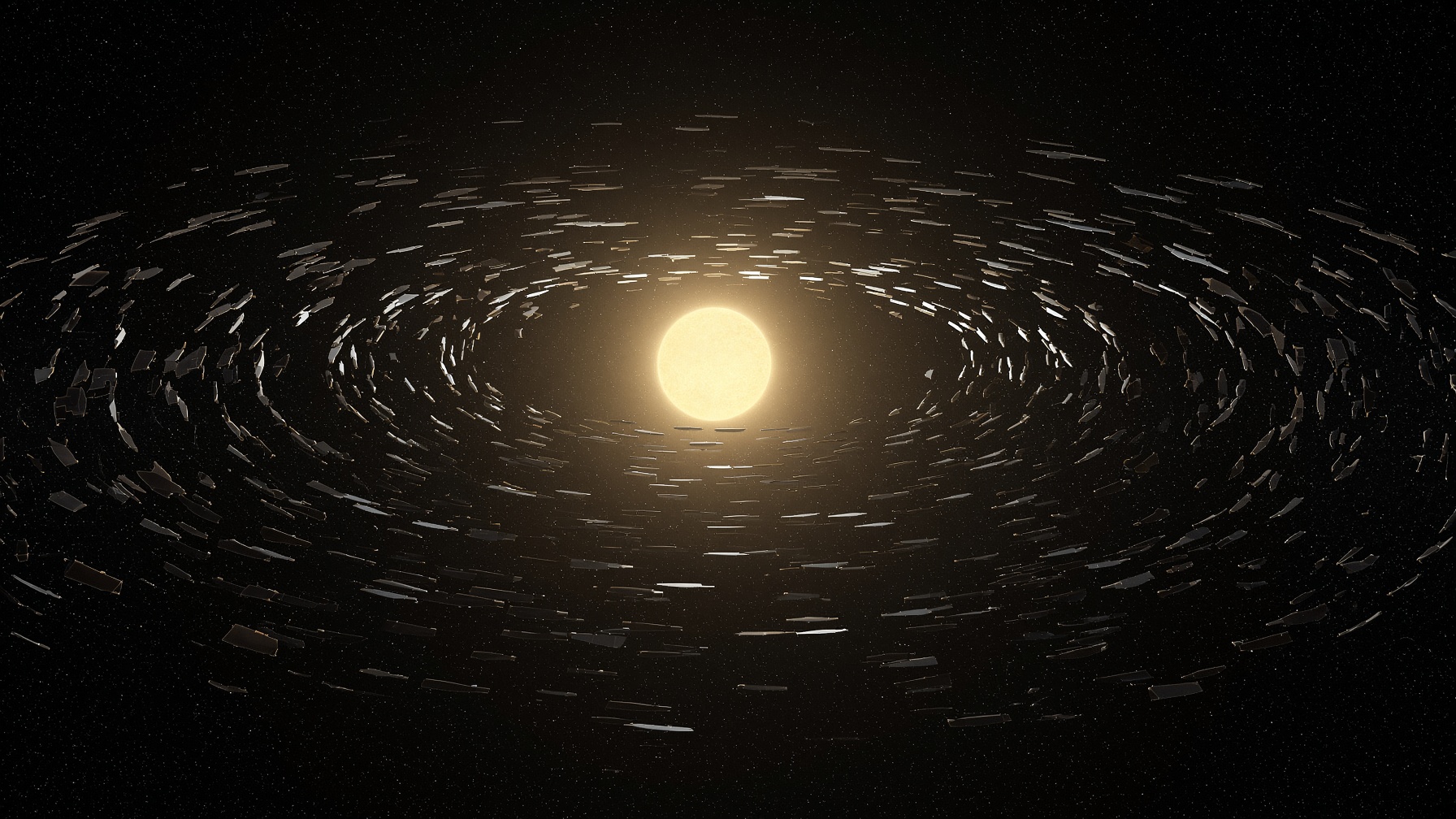
Later convention sets Type II near 1 × 10²⁶ W. A Dyson swarm is a hypothetical population of orbital collectors. Dyson himself refused the solid shell.

Modern planetary convention. 10²⁶ W. Dyson 1960 is the heat question.

Orbital collectors. Dyson refused the shell.

Dyson swarm designs

Concept art of a sparse swarm of orbital collectors. The star remains visible.

Independent orbits

A loose collection around the star

Dyson’s sentence: a swarm of objects traveling on independent orbits. Collectors, habitats, whatever the inhabitants chose. The star remains visible through the gaps until coverage is high. Orbits at one radius can intersect.

Intercepted 3.8 × 10²⁴ W · starlight left 99%

Concept art. Not a telescope frame.

Architecture

Dyson proposed a search for waste heat. The picture people remember is a hull. The search does not need a hull.

A thought: one hundredth of the IAU 2015 nominal solar luminosity.

One percent of the Sun is 3.8 × 10²⁴ W. Earth 2025 is 1.90 × 10¹³ W. That is 11 orders of magnitude between a living civilization and a sparse swarm.

Named sources
  • Freeman J. Dyson, Search for Artificial Stellar Sources of Infrared Radiation”, Science 131, no. 3414 (1960): 1667–1668.
  • Freeman J. Dyson, letter to the editor, Science 132, no. 3421 (1960): 250–253.
  • Jason T. Wright, Dyson Spheres”, Serbian Astronomical Journal, no. 200 (2020): 1–18.

Infrared signatures of a hypothetical swarm

False-color infrared illustration of a star with a dusty envelope.

False color · labeled

Observation

A mid-infrared excess

If collectors, or dust, or both, surround a star, unused energy leaves as heat. A far instrument would see extra light between a few and a few tens of micrometres. That is the observation. Cause is not yet named.

False color, labeled. Dust is the first alternative.

Wavelength spine

Dyson asked for a search around 10 μm. Optical light peaks near half a micrometre. The gulf is what an instrument would notice.

optical10 μmW4

300 K · peak 9.7 μm

Dyson 1960 upper bound; ~10 μm. A 1 au radiator around a Sun-like star.

Observation is the excess. Waste heat is a hypothesis. Dust is another. A single glow does not conclude a civilization.

Named searches
  • Freeman J. Dyson, Search for Artificial Stellar Sources of Infrared Radiation”, Science 131, no. 3414 (1960): 1667–1668.
  • Richard A. Carrigan Jr., IRAS-Based Whole-Sky Upper Limit on Dyson Spheres”, Astrophysical Journal 698 (2009): 2075.
  • J. T. Wright et al., The Ĝ Infrared Search for Extraterrestrial Civilizations with Large Energy Supplies. II”, Astrophysical Journal 792 (2014): 26.
  • M. Suazo et al., Project Hephaistos II”, Monthly Notices of the Royal Astronomical Society 531 (2024): 695.
  • Bo-Lun Huang, Zhen-Zhao Tao, and Tong-Jie Zhang, WISE/CatWISE Constraints on Dysonian Waste-Heat Technosignatures in Nearby Galaxies”, Astronomical Journal 171 (2026): 131.

Type III

A galaxy is a power

Later convention sets Type III near 1 × 10³⁶ W. Kardashev 1964 used 4.0 × 10³⁷ W, the energy scale of a galaxy.

Modern planetary convention. 10³⁶ W. Kardashev 1964 original: 4 × 10³⁷ W.

Three papers

The walk used three named questions: energy for a signal, a decimal so Earth could sit between types, and the heat a distant instrument might see.

1964

The original question

Kardashev was thinking about radio information from possible extraterrestrial civilizations. More power might change which signals could be sent, and what distant observers might detect. A thought experiment about energy and communication.

N. S. Kardashev, Transmission of Information by Extraterrestrial Civilizations”, Soviet Astronomy 8 (1964): 217–221.

1973 / 2009

A continuous K

Sagan proposed a decimal interpolation so a civilization could sit between whole types. Type 1.0 at 10¹⁶ W. Earth then near 0.7 at about 10¹³ W. The algebraic form is the interpolation as printed later. It is not a sentence quoted from the 1973 book.

Carl Sagan, The Cosmic Connection: An Extraterrestrial Perspective (New York: Doubleday, 1973).

1960

Heat we might see

Dyson asked whether large-scale conversion of starlight would leave infrared waste heat. The collectors would be a swarm, or perhaps sails hanging on light. A solid shell cannot stand. A candidate infrared excess may be dust.

Freeman J. Dyson, Search for Artificial Stellar Sources of Infrared Radiation”, Science 131, no. 3414 (1960): 1667–1668.

Night-side Earth, city lights as warm filaments.

Return

What would we see?

Another civilization might command a planet, a star, a galaxy. If they converted that light, a distant dish might see heat, not a city. Dust can occupy the same band. The first light is still a watt.